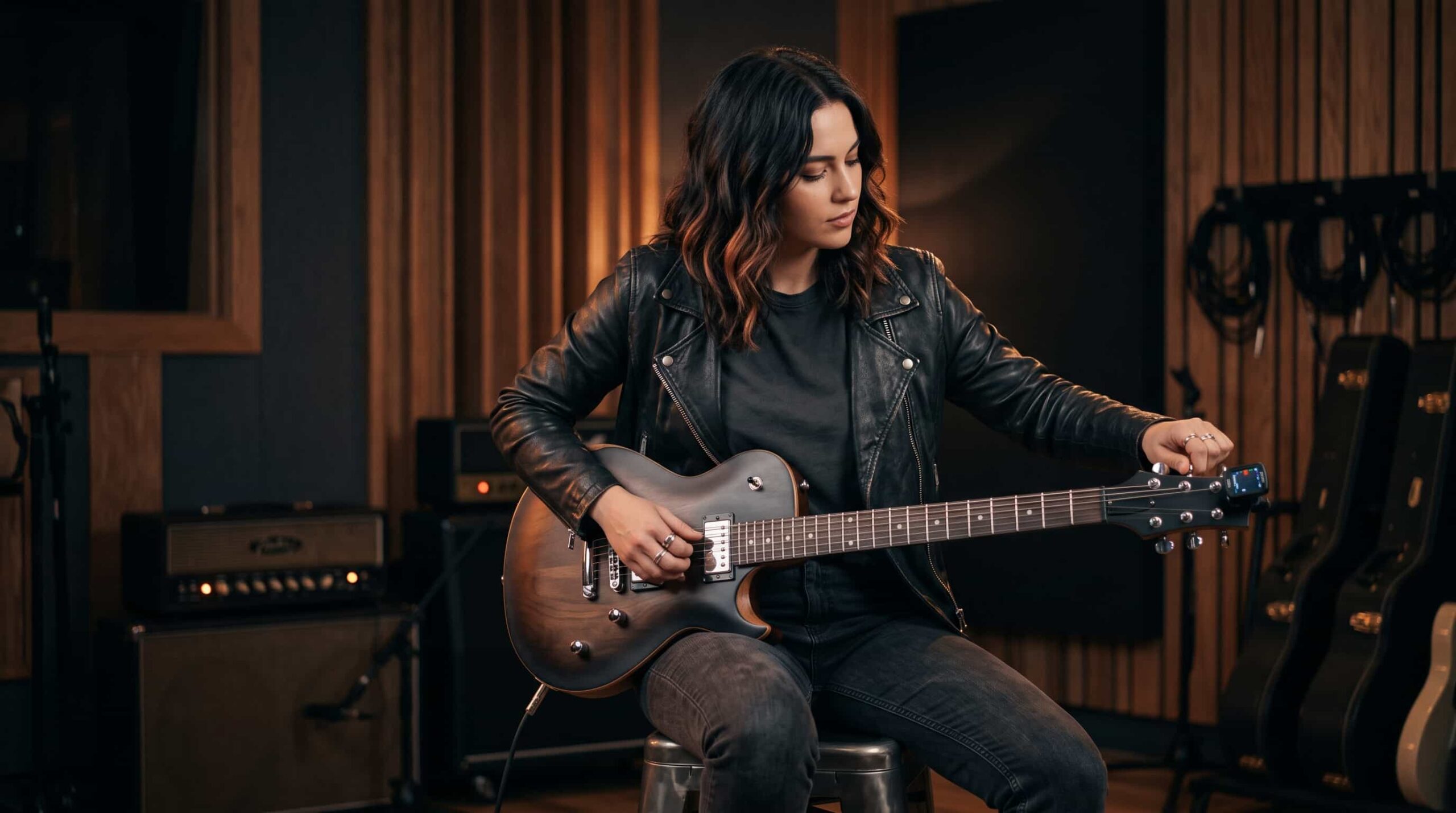
Drop D is one of the simplest alternate tunings you can use on guitar.
You only change one string.
In standard tuning, the six strings are:
E – A – D – G – B – E
In Drop D, the lowest E string is tuned down one whole step to D:
D – A – D – G – B – E
That small change has a surprisingly large effect. It gives the guitar a deeper low end, makes power chords easier to play and opens up riffs and chord shapes that feel very different from standard tuning.
What actually changes in Drop D?
Only the sixth string changes.
Your five higher strings remain exactly where they are in standard tuning, so most familiar scale shapes, chord shapes and lead playing still work normally.
The difference is the lowest string.
Instead of:
E2
you tune it down to:
D2
This extends the guitar’s range by one whole tone and gives you a lower bass note without changing the rest of the instrument.
That is one reason Drop D is so popular. It sounds noticeably different without forcing you to relearn the entire fretboard.
How to tune a guitar to Drop D
Start with your guitar in standard tuning.
Then lower the sixth string from E2 to D2.
The final tuning should be:
D2 – A2 – D3 – G3 – B3 – E4
The easiest way is to use a tuner that includes Drop D as a tuning option.
You can also tune it by ear.
Play the open fourth string, which is D3, and compare it with the sixth string. Lower the sixth string until it becomes a D one octave below the fourth string.
If you are not confident about hearing octaves, use a tuner instead. It is faster and removes the guesswork.
After lowering the string, check the other strings again. On guitars with floating tremolo systems, changing the tension of the sixth string can slightly affect the tuning of the others.

Why power chords become easier
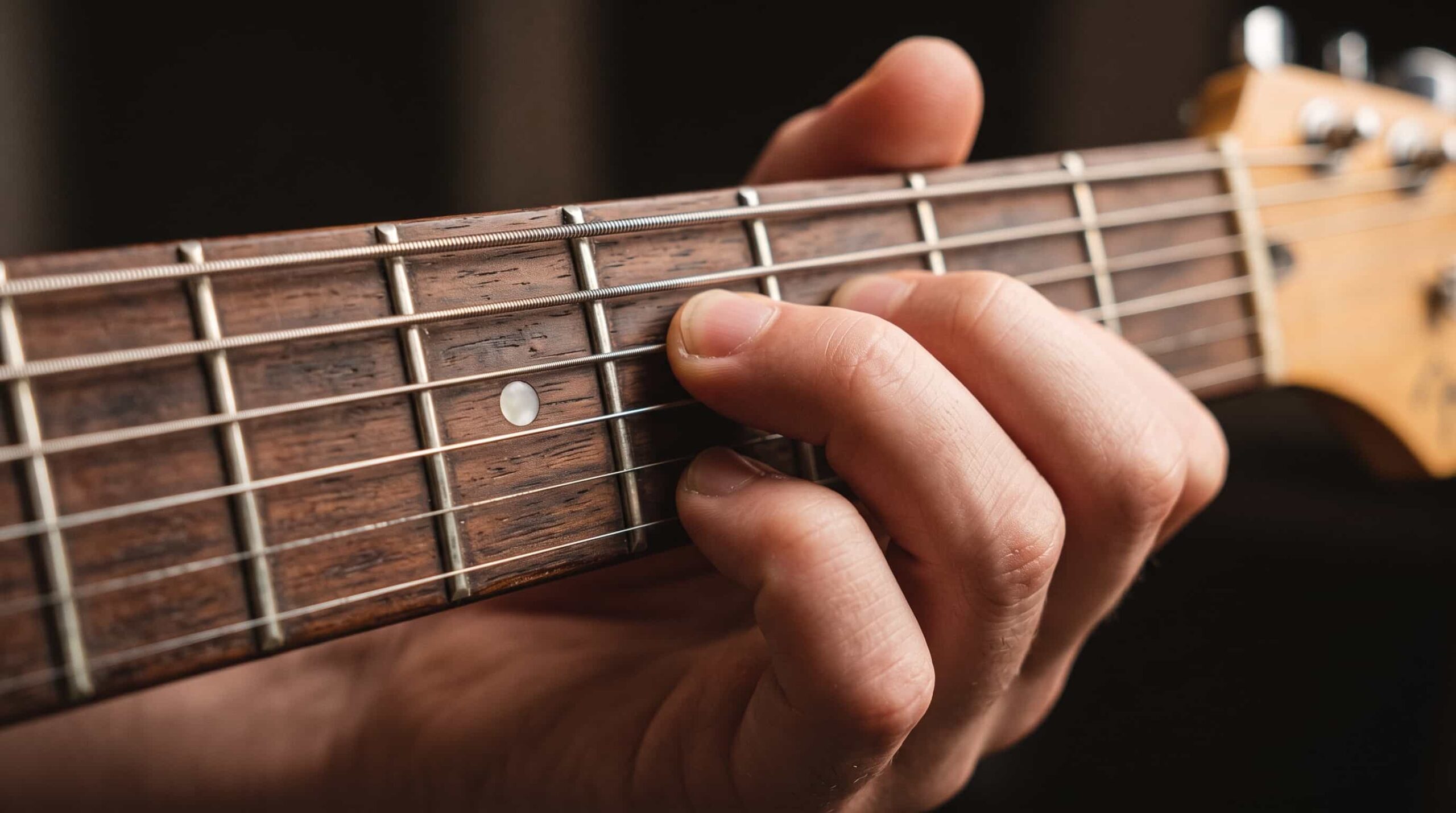
One of the biggest advantages of Drop D is the way it changes power chord shapes.
In standard tuning, a root-fifth-octave power chord across the lowest three strings usually requires more than one fret position.
In Drop D, those same low-string power chords can often be played with one finger across three strings.
For example, barring the sixth, fifth and fourth strings at the same fret produces a movable power chord shape.
That makes fast chord changes, heavy riffs and rhythmic patterns much easier.
It is one reason Drop D became so common in rock, metal, alternative music and heavier styles.
Why riffs sound heavier
The low D adds extra weight to the guitar.
A riff that ends on the open sixth string now lands on D instead of E, which immediately changes the character of the part.
The lower pitch can make palm-muted riffs sound bigger and more aggressive, especially with distortion.
But Drop D is not only useful for heavy music.
The open D also works well in acoustic playing, fingerstyle and more atmospheric arrangements because it creates a strong low drone that can continue ringing underneath higher notes.
Open strings become more useful
Drop D creates several useful relationships between the open strings.
You now have:
- low D on the sixth string
- D on the fourth string
- another D available higher on the fretboard
That makes it easier to build chords and riffs around D while allowing open strings to ring.
You can create large-sounding chord voicings that would be awkward or impossible in standard tuning.
This is one reason Drop D often appears in songs where the guitar sounds unusually wide even though the chord shapes are relatively simple.
Does Drop D change your normal chord shapes?
Most of them stay the same.
Any chord that does not use the sixth string can be played exactly as before.
Chords that include the low E string need more attention because that string is now two semitones lower.
For example, a familiar E major or G major shape that uses the sixth string will no longer produce exactly the same chord unless you adjust the bass note.
This is not necessarily a disadvantage.
It encourages different voicings and can make familiar chords sound fresh.
Standard tuning vs Drop D
The main difference is simple:
Standard: E – A – D – G – B – E
Drop D: D – A – D – G – B – E
Standard tuning is more symmetrical for general guitar playing and keeps familiar chord and scale relationships intact across all six strings.
Drop D sacrifices some of that consistency in exchange for:
- a lower bass note
- easier power chords
- open D drones
- different chord voicings
- heavier low-register riffs
Neither tuning is better.
They simply encourage different kinds of playing.
Do you need thicker strings for Drop D?
Usually not.
If you only tune the sixth string down from E to D, a normal set of guitar strings will generally work fine.
The low string will feel slightly looser because it has less tension.
Some players like that softer feel. Others prefer a heavier sixth string for a tighter response.
If you use Drop D occasionally, there is normally no reason to change string gauge.
If you play permanently in lower tunings or use very aggressive picking, a heavier set may feel more stable.
What about guitars with floating tremolos?
Drop D is easiest on fixed-bridge guitars.
With a floating tremolo, lowering the tension of one string changes the balance between the strings and the tremolo springs.
That can cause the other five strings to move slightly sharp.
You may then need to retune several times before everything settles.
Some floating systems are also configured specifically for one tuning, so switching back and forth can be inconvenient.
It still works, but it is less immediate than on a hardtail, Telecaster-style bridge or fixed Les Paul-style bridge.
Is Drop D good for beginners?
Yes.
In fact, it is probably one of the best alternate tunings to try first.
You only change one string, the basic fretboard remains familiar and the results are obvious immediately.
It also lets beginners experiment with heavier riffs and simple power chord shapes without having to learn a completely different tuning system.
The main thing is remembering that the sixth string is no longer E.
If a familiar chord suddenly sounds wrong, that is usually why.
Why guitarists keep coming back to it
Drop D is popular because it offers a lot without demanding much.
One tuning change gives you a lower range, simpler power chords and new harmonic possibilities while leaving most of the guitar exactly as you already know it.
You can switch to it in seconds and return to standard tuning just as easily.
For rock and metal players, it can make riffs feel heavier and more direct. For acoustic players, it adds depth and useful open-string resonance.
That combination of simplicity and flexibility is why Drop D has remained one of the most widely used alternate tunings on guitar.