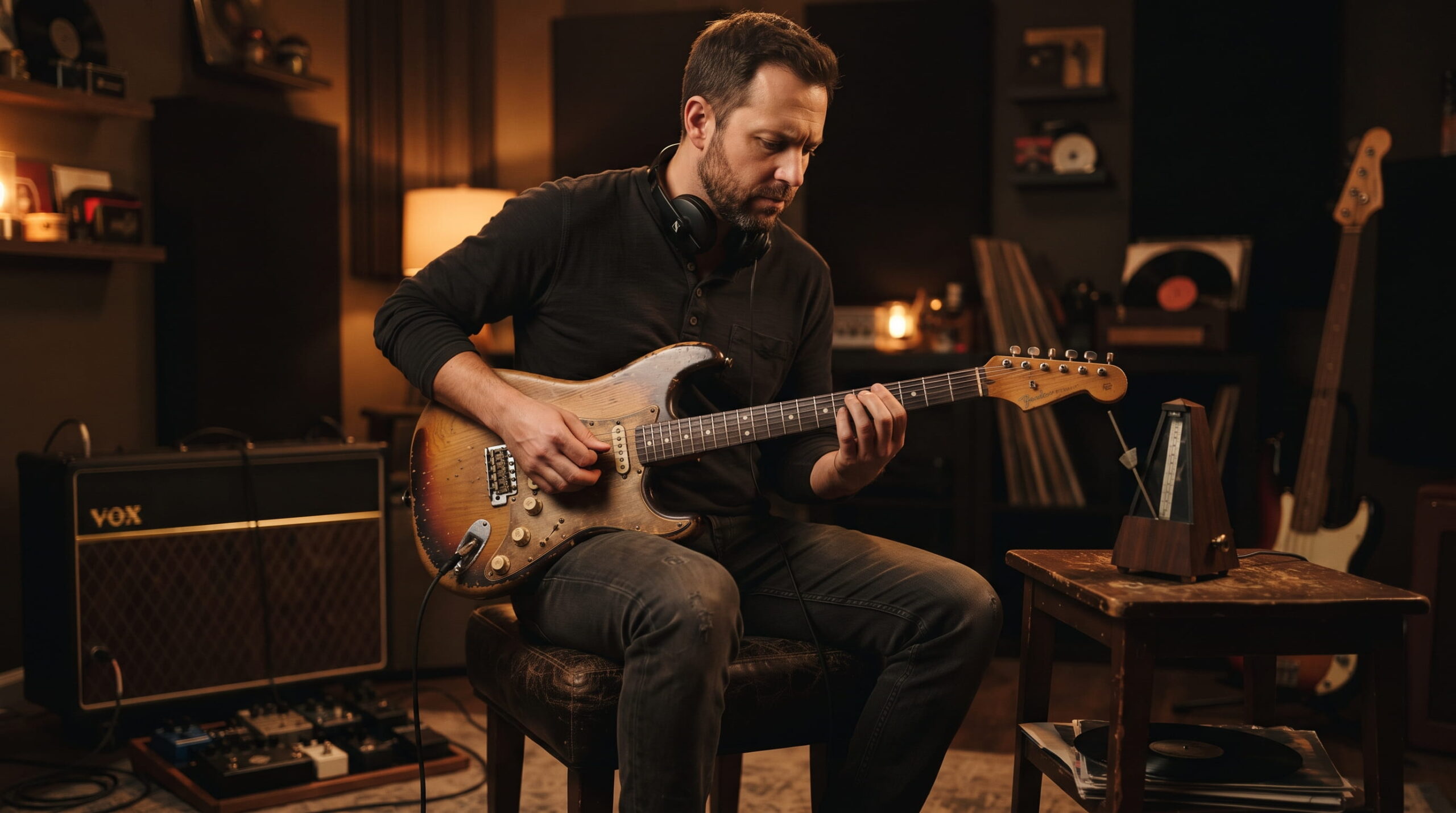
Practising with a metronome is one of the simplest ways to improve your timing, but it can also become monotonous surprisingly quickly. Set a tempo, play the same exercise for ten minutes, increase the BPM, repeat. It works, but it is hardly the most inspiring way to spend a practice session.
The problem is usually not the metronome itself. It is how it is being used.
A metronome can be much more than a device that clicks at a fixed speed. Used creatively, it can expose weak spots in your playing, make familiar exercises feel different and turn a repetitive technical session into something much closer to making music.
Stop treating the metronome like a speed test
One of the most common habits is to associate the metronome almost entirely with speed.
You play an exercise at 100 BPM. If it goes well, you try 105. Then 110. Eventually the exercise falls apart and you know where your current limit is.
There is nothing wrong with doing this occasionally, but speed should not be the only goal.
Try using the same exercise at several tempos without necessarily moving upwards. Play it at 70 BPM, then 95, then back down to 60. Slower tempos often expose timing problems that disappear when notes are packed closely together.
You may discover that playing accurately at 55 BPM is harder than playing the same phrase at 100.
Change what the click represents
A metronome does not have to click on every beat.
If you normally practise in 4/4 with four clicks per bar, try imagining that the metronome is only playing beats 2 and 4.
For example, if you want to practise something at 100 BPM, set the metronome to 50 BPM and treat each click as the second and fourth beat of the bar.
This immediately gives you more responsibility for maintaining the pulse yourself.
Once that feels comfortable, make the click even less frequent. You can treat one click as the beginning of each bar or even every second bar.
The fewer reference points you have, the easier it becomes to hear whether your internal timing is actually stable.
Use different subdivisions
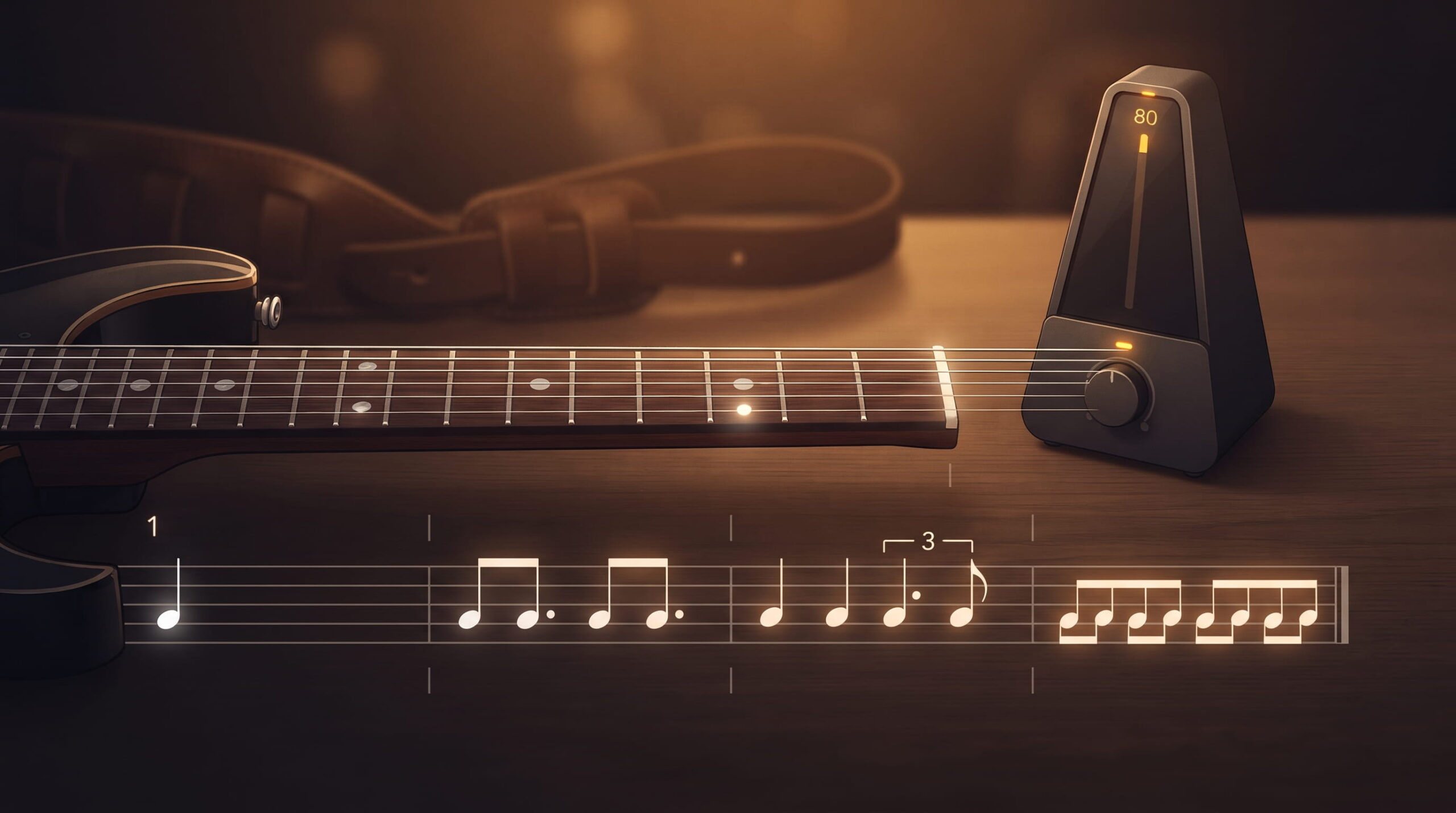
Playing endless quarter notes against quarter-note clicks gets old quickly.
Instead, keep the same tempo and change the rhythmic subdivision.
A simple scale can become several different exercises:
- quarter notes
- eighth notes
- eighth-note triplets
- sixteenth notes
The notes themselves do not need to change. Your rhythmic relationship with the metronome does.
This is particularly useful because musicians often discover that they are comfortable with one subdivision but much less consistent with another.
Triplets are a good example. Someone who sounds perfectly comfortable playing straight eighth notes may suddenly feel much less secure when the same tempo is divided into three equal parts.
Put the metronome behind actual music
Technical exercises are useful, but they should not be the only thing you practise with a click.
Take a riff, chord progression, solo section or rhythm part that you already know and play that with the metronome instead.
This makes the practice session feel less mechanical while still developing timing.
It also reveals something that scale exercises sometimes hide: your timing may change when the music becomes physically awkward.
A difficult chord change, string skip or position shift can cause a slight hesitation. Without a metronome, that hesitation can easily go unnoticed.
Turn short phrases into timing exercises
You do not need a long exercise.
Take a four- or five-note lick and repeat it against the metronome. Then start that same phrase on a different part of the beat.
Play it:
- directly on the beat
- starting on an eighth-note offbeat
- starting on the second sixteenth note
- starting after a short rest
The fingering can remain exactly the same while the rhythmic feel changes completely.
This is a useful way to make a familiar lick feel unfamiliar again.
Use short bursts instead of long repetitions
Another reason metronome practice becomes boring is simply that the same exercise continues for too long.
Instead of repeating one thing for fifteen minutes, try working in shorter blocks.
For example:
Two minutes: alternate picking
Two minutes: rhythm guitar
Two minutes: a difficult lick
Two minutes: chord changes
Two minutes: improvisation
Keep the metronome running and change the musical task.
Ten minutes can pass very quickly when the focus changes every couple of minutes.
This approach also makes it easier to stay mentally engaged. Once your attention disappears, mechanically repeating an exercise usually provides diminishing returns.
Occasionally remove the click
One of the most revealing metronome exercises is to stop hearing it.
Play along for several bars, mute the metronome for a short period and then bring it back.
If your timing is solid, you should still be close to the click when it returns.
If you are noticeably ahead or behind, you have learned something useful about your internal pulse.
A gap trainer automates this idea by alternating between audible and silent bars, but you can also practise it manually.
It feels surprisingly different from simply following continuous clicks because you are forced to become the timekeeper.
Practise at tempos that feel uncomfortable
Most guitarists have tempos where a particular technique feels natural.
That is exactly why it can be useful to practise just outside those comfortable zones.
A riff might feel easy at 120 BPM but strangely awkward at 85. Instead of immediately changing the tempo, stay there for a while.
Awkward tempos often expose movements and timing habits that comfortable speeds disguise.
The goal is not always to play faster. It is to become comfortable wherever the tempo happens to be.
Use the metronome as part of the music
The most useful shift is to stop thinking of the metronome as something you are fighting against.
The click is another rhythmic element.
Try listening to it as if it were a percussion instrument. Lock your notes into it rather than merely trying not to fall behind.
When the timing is right, there is often an interesting sensation: the click seems to disappear into your playing. Your notes and the metronome land so closely together that they almost become a single sound.
That is usually a much better target than simply reaching another five BPM.
A good metronome session should leave you more aware of rhythm, not just more tired from repeating the same exercise. Change the subdivisions, remove clicks, work with real music and vary the task frequently enough to keep your ears involved.
The metronome is repetitive by design. Your practice session does not have to be.
See It in Practice
Tomo Fujita demonstrates how working with a metronome can become part of the musical process rather than just a mechanical timing exercise. Pay attention to how the click supports the groove instead of dominating it.