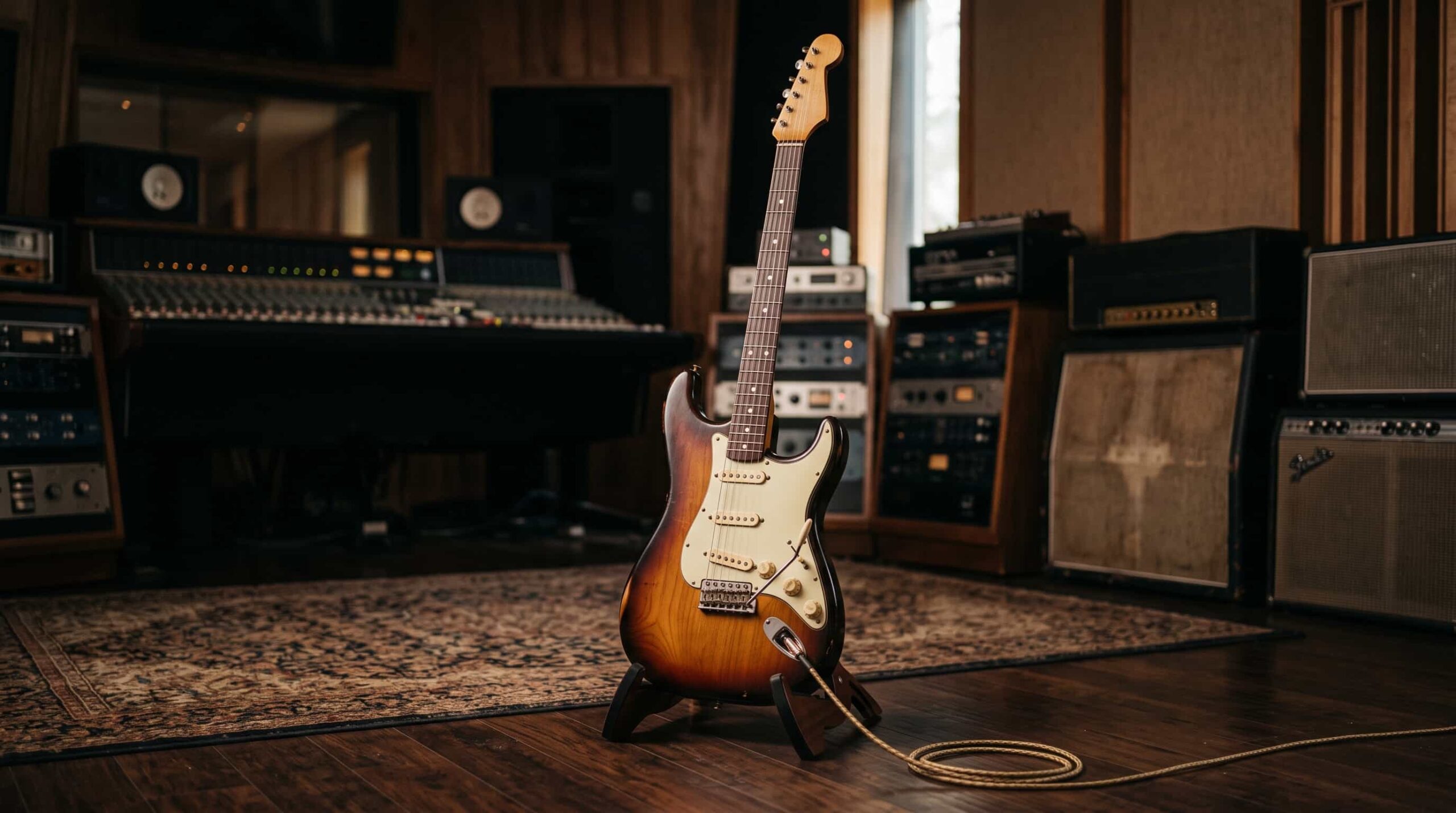
Few electric guitars are as instantly recognisable as the Fender Stratocaster. Its double-cutaway body, three pickups and long upper horn have become part of the visual language of electric guitar.
The Stratocaster has been played by blues musicians, rock stars, session players, pop guitarists and experimental players for more than seventy years. It has appeared on countless records and stages, but its reputation is not based on history alone.
A large part of its success comes from something much simpler: it is an extremely adaptable design.
It looked different from almost everything that came before
When the Stratocaster appeared in the 1950s, solid-body electric guitars were still relatively new.
Fender already had the Telecaster, a guitar with a deliberately simple construction and a more angular body. The Stratocaster took a different direction.
Its body was more sculpted, with contours designed to sit comfortably against the player. The double cutaways made the upper frets easier to reach, while the extended horns gave the instrument its distinctive silhouette.
Those details might seem normal today, but they helped make the Stratocaster feel unusually modern for its time.
The basic outline has changed remarkably little since then.
Three pickups created a much wider tonal range
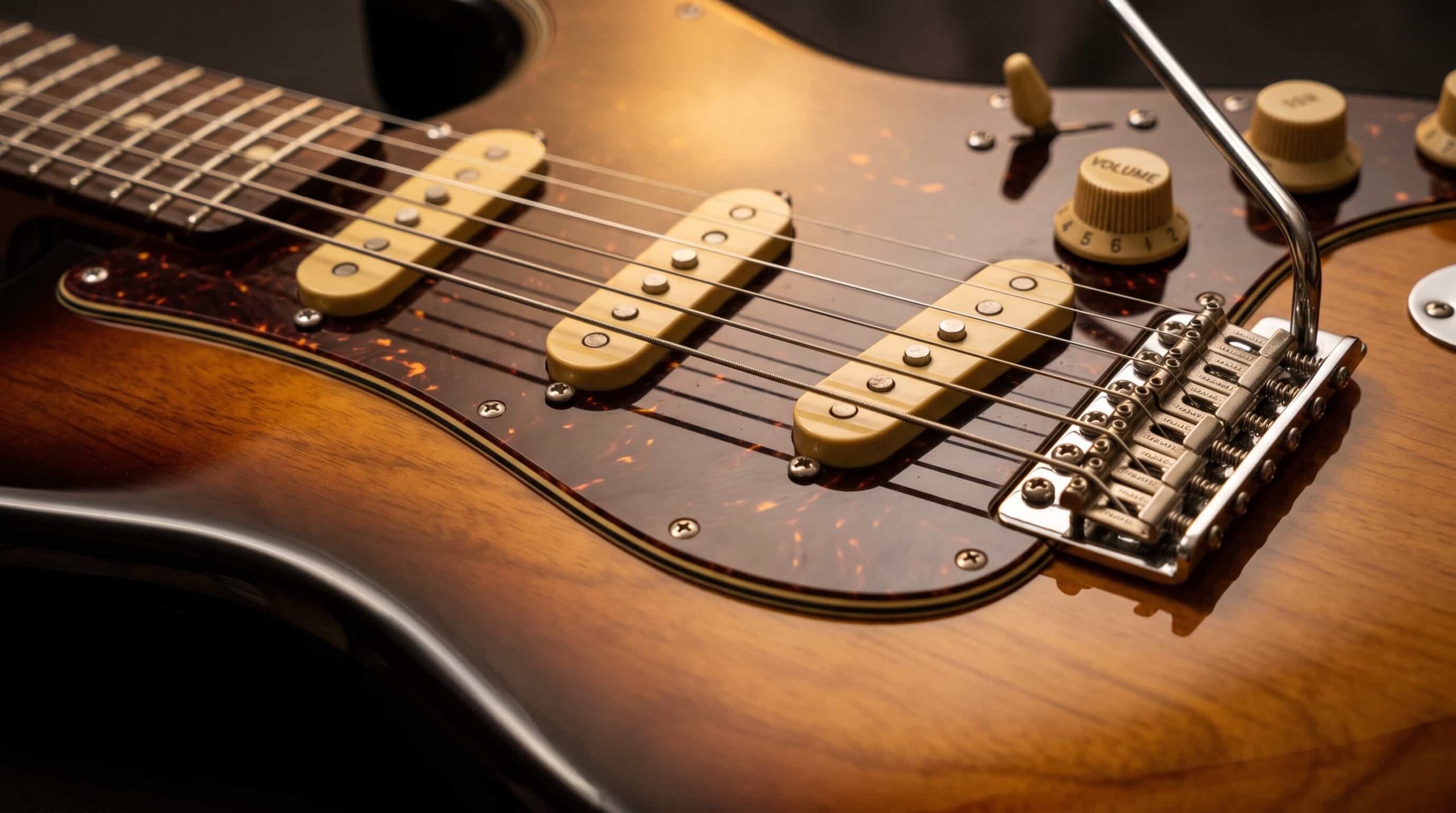
One of the Stratocaster’s defining features is its three single-coil pickup layout.
That gave players more tonal choices than many competing guitars of the period.
The bridge pickup could produce a sharper, more aggressive sound. The neck pickup offered something warmer and rounder. The middle pickup added another character entirely.
Players later discovered the distinctive tones created by combining adjacent pickups. Those in-between sounds became closely associated with funk, blues, pop and clean rhythm guitar.
Today, a five-way selector switch feels completely normal on a Strat-style guitar, but that flexibility became one of the reasons the design could fit into so many musical styles.
A Stratocaster can sound delicate and clean one moment and surprisingly aggressive the next.
The tremolo system became part of its personality
Another important feature was Fender’s synchronised tremolo system.
Despite commonly being called a tremolo, the bridge actually changes pitch, making it technically a vibrato system.
The distinction matters less than what guitarists did with it.
Some players used the arm for subtle chord movement or gentle pitch bends. Others turned it into something far more dramatic.
Jimi Hendrix used the Stratocaster’s tremolo as part of his expressive vocabulary. Later, players such as Jeff Beck developed an extraordinary level of control with the bridge, using it almost like another instrument.
The system is not perfect. A traditional Strat tremolo can create tuning problems when set up poorly or used very aggressively.
But its musical possibilities became part of the Stratocaster identity.
Famous players kept reinventing what a Strat could sound like
The Stratocaster benefited enormously from the musicians who adopted it.
Buddy Holly helped establish the instrument visually during the early years of rock and roll. Jimi Hendrix completely changed expectations of what an electric guitar could do. Ritchie Blackmore used the Strat for hard rock and early heavy metal. David Gilmour made it central to some of rock’s most recognisable guitar tones.
Then came players such as Stevie Ray Vaughan, Eric Johnson, Yngwie Malmsteen and many others, each using essentially the same basic guitar in very different ways.
This is one reason the Stratocaster never became associated with a single genre.
Hendrix did not sound like Gilmour. Gilmour did not sound like Vaughan. Vaughan did not sound like Malmsteen.
Yet all of them found something useful in the same fundamental design.
It is one of the easiest guitars to modify
The Stratocaster also became popular with guitarists who like changing their instruments.
Its bolt-on neck, removable pickguard and relatively modular construction make many modifications straightforward compared with guitars built around more integrated designs.
Pickups can be replaced. Electronics can be rewired. Bridges, tuners and pickguards can be changed. Neck shapes and fretboard materials can vary dramatically while the guitar still remains recognisably a Strat.
That flexibility helped create an enormous aftermarket.
It also led to countless personal variations.
Perhaps the most famous example of this culture is Eddie Van Halen’s Frankenstrat. Although it became something very different from a conventional Fender Stratocaster, its origins clearly reflected the Strat-style platform and the idea that a guitarist could modify an instrument around personal needs rather than accept the factory specification.
The design works for beginners and professionals
Another reason for the Stratocaster’s longevity is that the basic concept exists at almost every price level.
A beginner can buy an affordable Strat-style guitar and immediately become familiar with the same general controls, body shape and pickup layout used by professional musicians.
At the other end of the market are vintage examples, Custom Shop instruments and rare models that can cost extraordinary amounts of money.
Between those extremes are hundreds of variations.
Different neck profiles, fretboard radii, pickup types, bridges and electronics can make two Stratocasters feel surprisingly different while still sharing the same basic architecture.
That makes the design unusually easy to grow with.
It still feels modern
Perhaps the most impressive thing about the Stratocaster is that it does not feel like an antique design.
Many products from the 1950s look obviously tied to their era. The Stratocaster somehow avoided that.
Its shape still looks contemporary. Its controls remain practical. Its three-pickup layout is still versatile. Its modular construction still makes sense.
Modern guitar makers continue to produce instruments based heavily on the same formula, often adding flatter fretboards, locking tuners, humbuckers, modern tremolo systems or different neck shapes.
The details change, but the underlying idea remains familiar.
That may be the real reason the Stratocaster became iconic. It was not simply a guitar that happened to be used by famous musicians. It was a design flexible enough for each generation of players to reinterpret it.
More than seventy years after its introduction, guitarists are still finding new ways to make a Stratocaster sound like their own.