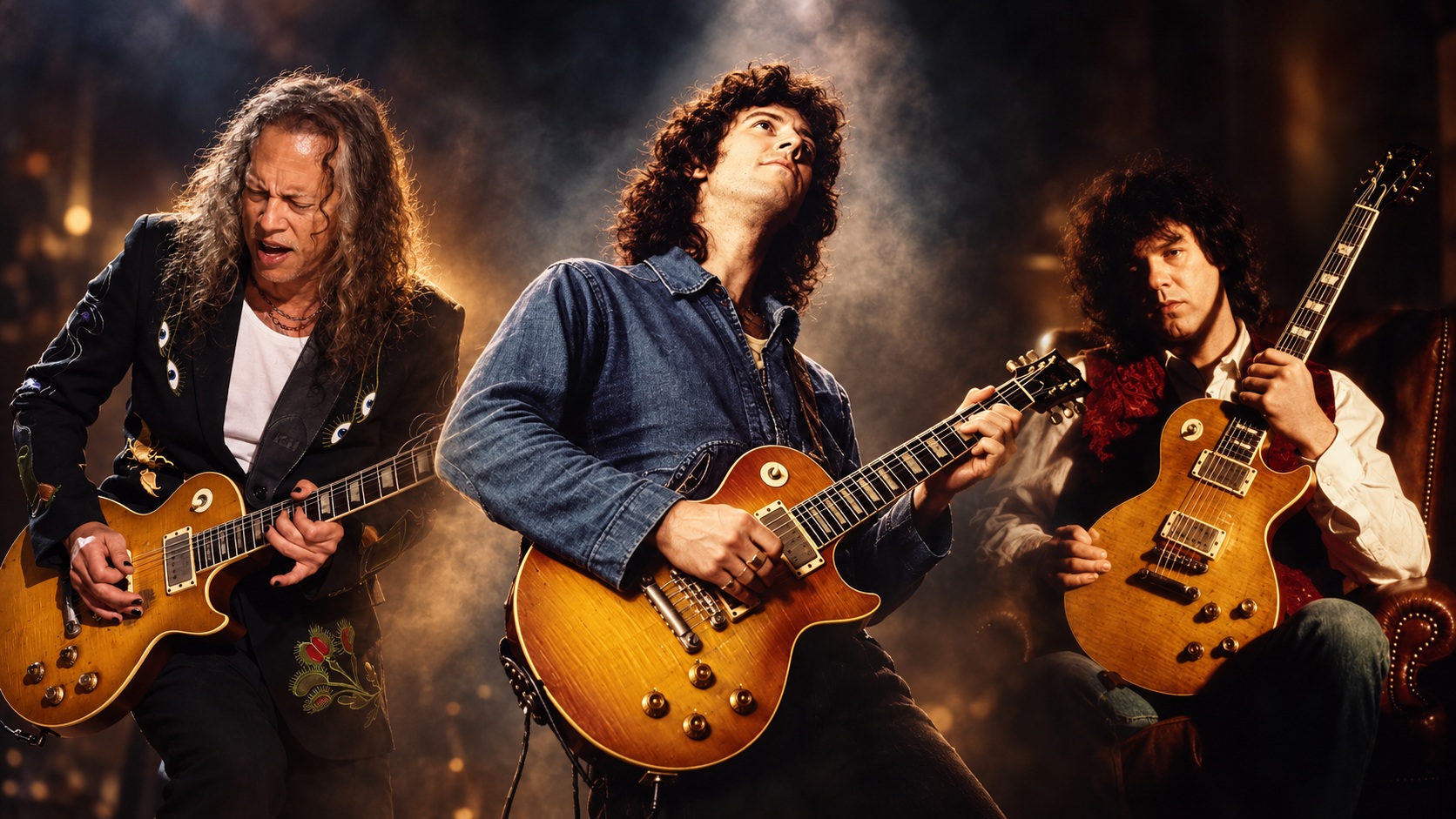
Some guitars become famous because of the musician who played them. Greeny is unusual because its story stretches across three completely different players and several generations of rock and blues.
The 1959 Gibson Les Paul Standard known as Greeny belonged first to Peter Green, later spent decades with Gary Moore and is now owned and regularly played by Kirk Hammett.
That alone would make it historically interesting. What really separates Greeny from most celebrity guitars, though, is that each owner actually used it as a musical instrument rather than treating it as a museum piece.
Peter Green and the sound that made Greeny different
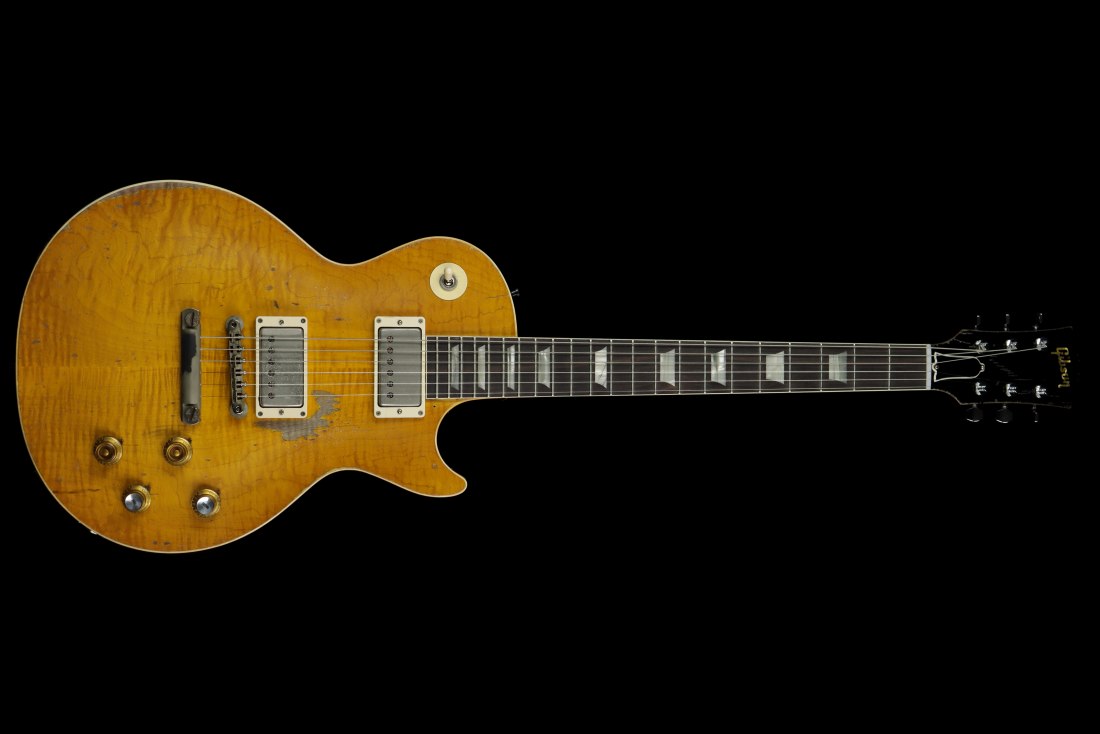
Peter Green acquired the guitar during the period in which he was playing with John Mayall’s Bluesbreakers and later used it extensively with Fleetwood Mac.
At the time, it was simply a late-1950s Les Paul Standard. Over the years, however, the original cherry sunburst faded dramatically, helping create the pale, worn appearance now associated with Greeny.
The guitar’s most famous characteristic is its unusual middle-position sound.
On a conventional two-humbucker Les Paul, selecting both pickups normally produces a full, blended tone. Greeny behaves differently because the neck pickup has reversed magnetic polarity. When both pickups are selected, certain frequencies partially cancel each other, producing the thin, hollow and almost vocal sound now closely associated with Peter Green.
There is some mythology around exactly how the modification happened. Gibson’s account says Green had been experimenting with the guitar and accidentally reinstalled the neck pickup backwards. The visible reversed pickup is part of Greeny’s appearance, but the unusual out-of-phase sound comes principally from the reversed magnetic polarity.
For Green, it was not merely an odd technical feature. That sound became part of his remarkably expressive playing style.
How Gary Moore ended up with Greeny
Greeny might easily have disappeared into a private collection after Peter Green’s Fleetwood Mac years. Instead, it passed to another extraordinary guitarist.
Around 1970, Peter Green met the young Gary Moore when Moore’s band Skid Row was supporting Fleetwood Mac. Green initially let him use the Les Paul and later offered to sell it to him.
Moore would keep the guitar for roughly three decades.
That period is important because Greeny stopped being simply “Peter Green’s Les Paul”. It became equally associated with Gary Moore’s much more aggressive and powerful playing.
Moore used the guitar with Thin Lizzy and throughout his solo career. In 1995, he even recorded Blues for Greeny, an album dedicated to Peter Green and his music.
The contrast between the two players is part of what makes the guitar so interesting.
Peter Green was known for space, touch and economy. Gary Moore could be explosive, with huge sustain, heavy vibrato and a much more forceful attack.
The same guitar worked for both.
Greeny leaves Gary Moore
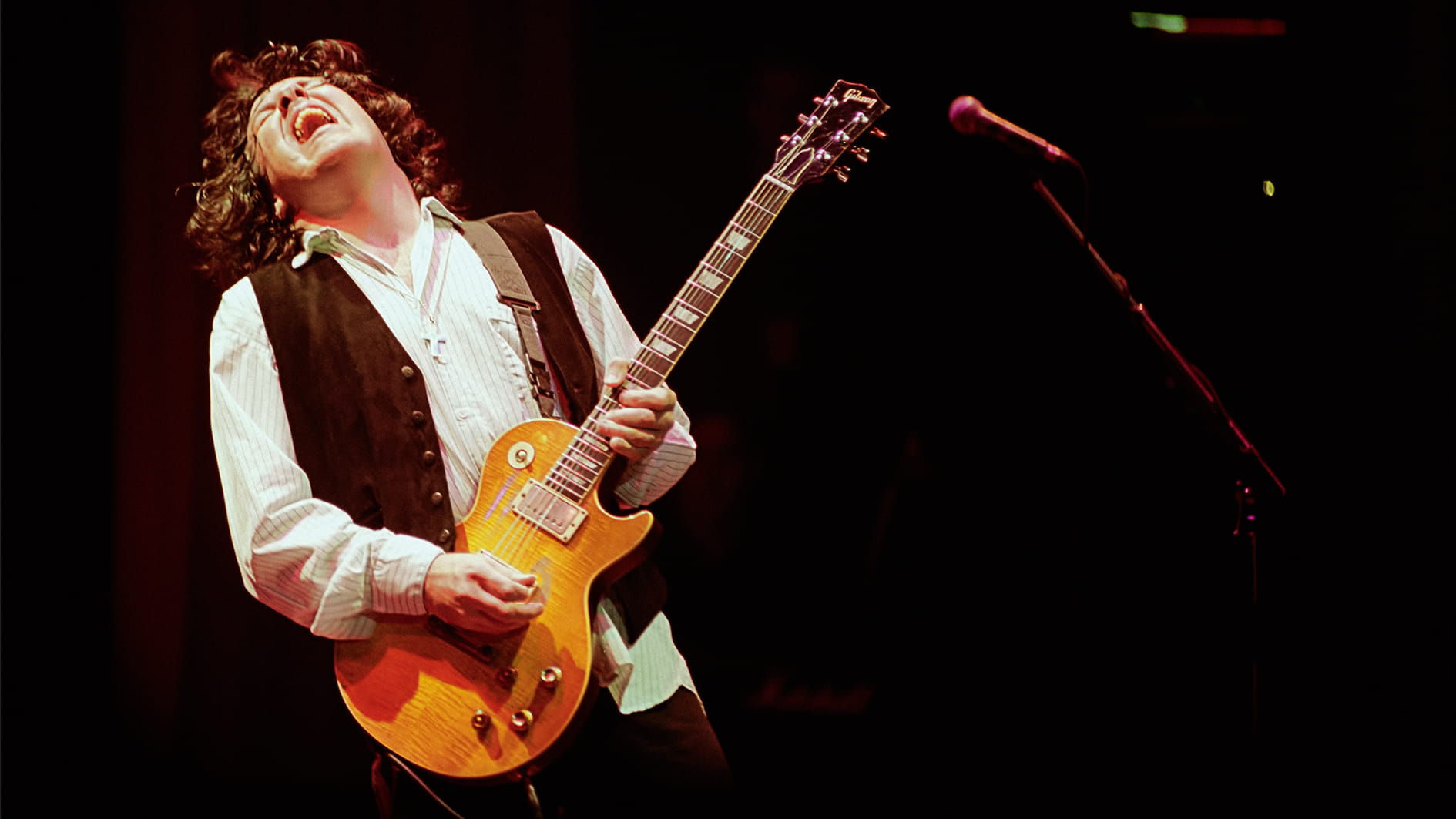
Gary Moore eventually sold Greeny in 2006.
From there, the guitar passed through the hands of collectors and dealers. For a while, it appeared that Greeny might follow the path of many historically important instruments and spend the rest of its life primarily as an expensive collectible.
That changed in 2014.
A dealer brought the guitar to Kirk Hammett while the Metallica guitarist was staying in a hotel. According to Gibson’s history of the instrument, Hammett even sought advice from Jimmy Page before deciding to buy it.
Greeny had found its third famous long-term owner.
Kirk Hammett actually plays it
One of the best things about Kirk Hammett owning Greeny is that he did not simply lock it away.
He has taken it on stage and continued using it as a working instrument.
That matters.
A 1959 Les Paul Standard is already one of the most desirable vintage electric guitars in existence. Add its history with Peter Green and Gary Moore and Greeny’s value becomes almost impossible to separate from its cultural significance.
It would be understandable for an owner to treat it like an irreplaceable artefact.
Hammett has taken a different approach. Greeny is valuable because of what musicians have done with it, so he continues playing it.
In that sense, the guitar’s story is still being written rather than merely preserved.
Three players, three completely different sounds
Greeny also demonstrates something guitarists sometimes forget when talking about expensive instruments.
A legendary guitar does not automatically create a legendary sound.
Peter Green, Gary Moore and Kirk Hammett sound almost nothing alike.
Green’s playing could be understated and haunting. Moore often pushed the guitar into enormous blues-rock tones. Hammett comes from the much heavier musical world of Metallica.
Yet all three were able to use the same 1959 Les Paul in ways that made sense for their own music.
The instrument has a recognisable character, particularly because of its unusual pickup configuration, but the player still dominates the result.
That may be one of the most interesting lessons in Greeny’s history.
Greeny has become a guitar of its own
Greeny’s reputation has grown to the point where it is no longer known merely as “a 1959 Les Paul Standard”.
It is simply Greeny.
Gibson and Epiphone now produce dedicated Greeny-inspired models, including versions designed to reproduce the reversed neck pickup and out-of-phase middle position of the original guitar.
Its serial number, 9 2208, has even become recognisable among enthusiasts familiar with the instrument.
Very few guitars reach that level of identity.
Greeny has survived changing owners, decades of touring and enormous changes in popular music. More importantly, it has never belonged to only one musical era.
Peter Green gave it its voice. Gary Moore carried that voice into another generation. Kirk Hammett brought it onto stages that Green could never have imagined when he first owned it.
For a guitar built in 1959, that is a remarkable amount of life.
Gary Moore’s years with Greeny helped give the guitar a second life far beyond its association with Peter Green. This live performance of Parisienne Walkways is a good example of the sustain, vibrato and dramatic phrasing that made Moore’s playing so distinctive.