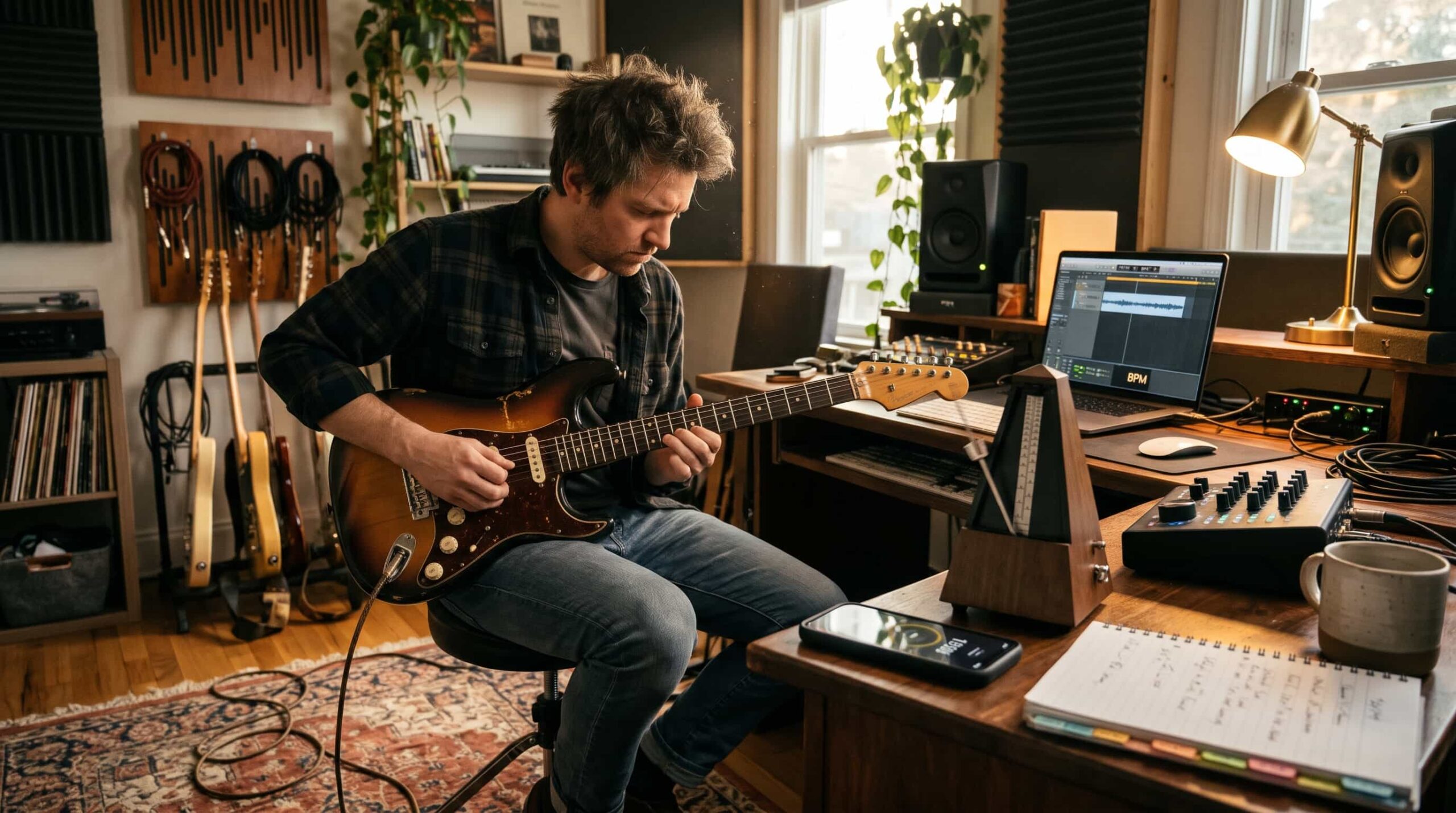
Good timing is one of those skills that becomes obvious the moment it is missing.
You can know the right notes, use the right chords and have solid technique, but if the rhythm moves around unpredictably, the whole performance can still feel unstable.
Timing is not simply the ability to follow a metronome.
It is the ability to place notes consistently, understand where you are inside the beat and keep playing with a steady pulse even when the rhythm becomes more complicated.
The good news is that timing can be trained very deliberately.
Start by making the beat feel obvious
Before working on complicated rhythms, make sure you can feel a basic pulse.
Set a metronome to a comfortable tempo and play one note on every click.
Do not worry about scales or technique.
Just concentrate on placing each note exactly with the beat.
Then try:
- one note every two clicks
- two notes per click
- four notes per click
The exercise is simple, but it forces you to hear the relationship between the beat and the notes you are playing.
If that relationship is not clear at slow tempos, faster practice will not fix it.
Stop treating the metronome as something to chase
A common mistake is reacting to the click instead of playing with it.
You hear the click, then play.
That creates a small delay.
The goal is to anticipate the beat so that your note and the click arrive together.
At first, this requires concentration.
Eventually, the metronome begins to feel less like an external signal and more like part of the rhythm you are already producing.
That is when timing starts to become more natural.
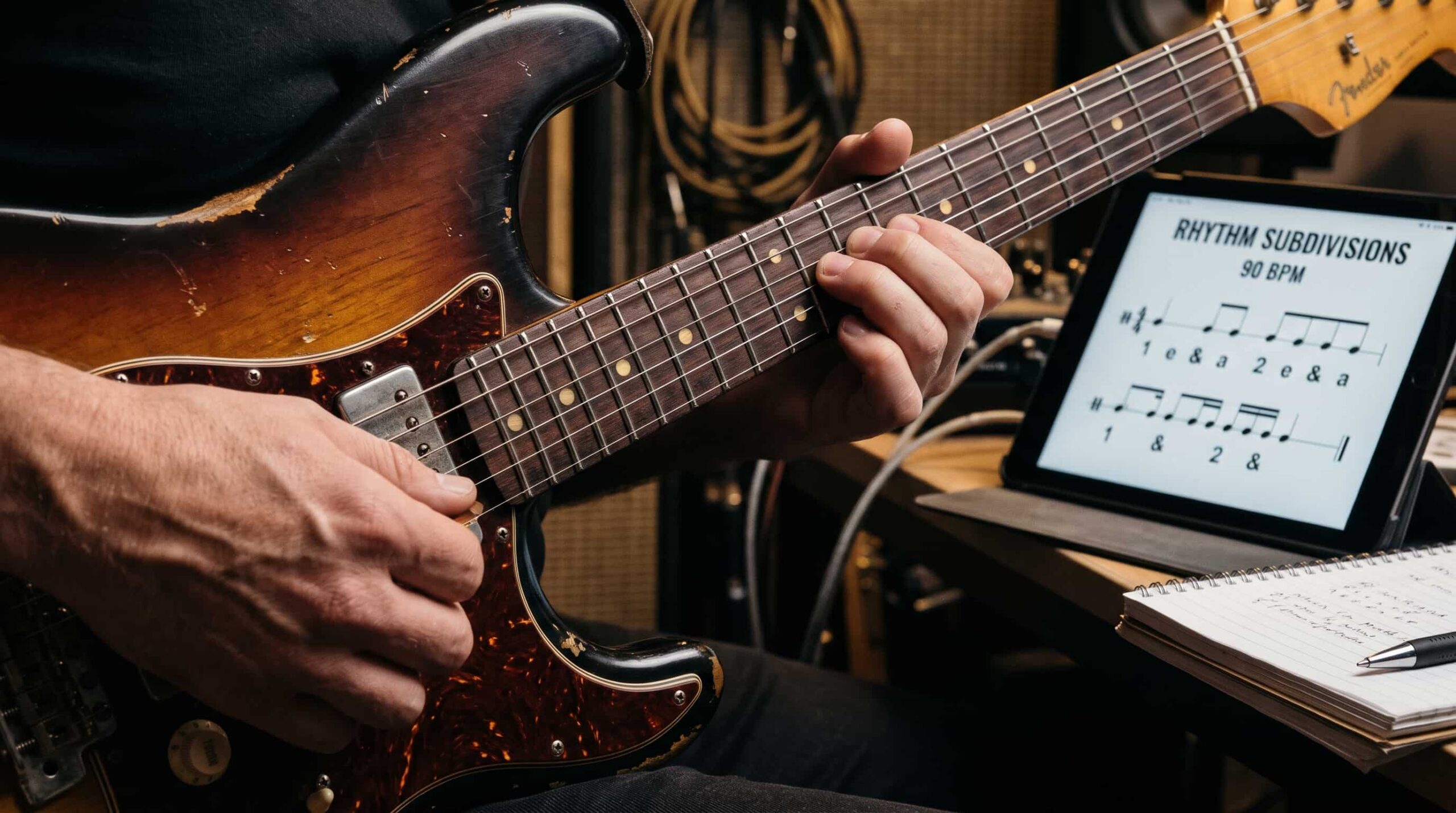
Practise with subdivisions
Playing quarter notes on the beat is useful, but real guitar parts rarely stay that simple.
You also need to feel what happens between the clicks.
Practise:
- quarter notes
- eighth notes
- triplets
- sixteenth notes
Keep the BPM the same and change only the subdivision.
This is one of the best ways to improve internal timing because the main beat stays constant while the number of notes between beats changes.
For example, at 80 BPM:
- quarter notes give you one note per beat
- eighth notes give you two
- triplets give you three
- sixteenth notes give you four
Your hands are moving differently, but the underlying pulse never changes.
Count out loud occasionally
Counting can feel awkward at first, but it helps connect what you hear with where you are in the bar.
For straight eighth notes, you might count:
1 and 2 and 3 and 4 and
For sixteenth notes:
1 e and a 2 e and a 3 e and a 4 e and a
You do not need to count every exercise forever.
Use it when a rhythm feels unclear.
If you cannot say where the notes fall, there is a good chance you are relying more on muscle memory than rhythmic understanding.
Practise slower than feels comfortable
Slow tempos expose timing problems.
At faster speeds, small inconsistencies can pass quickly enough that they are difficult to notice.
At 50 or 60 BPM, every beat has a lot of space around it.
If you rush, drag or lose the subdivision, you hear it immediately.
This is particularly useful for:
- chord changes
- rhythm guitar
- picking exercises
- bends placed on specific beats
- syncopated phrases
Slow practice is not easier practice.
In many cases, it is more demanding because there is nowhere to hide.
Record yourself
Your perception while playing is not always reliable.
You may feel perfectly locked in and then discover on playback that certain notes consistently arrive early or late.
Record a short exercise with a metronome or drum groove in the background.
Then listen without playing.
Ask yourself:
- Do the notes consistently land with the beat?
- Do I rush difficult sections?
- Do I slow down before chord changes?
- Are subdivisions evenly spaced?
- Do accents appear where I intended them?
Recording removes some of the distraction of physically playing and makes rhythmic problems easier to hear.
Practise rhythm separately from notes
If a passage is rhythmically difficult, simplify the harmony.
Instead of trying to play the full riff or chord progression immediately, mute the strings and practise only the picking or strumming pattern.
This removes fretting-hand difficulty from the exercise.
Once the rhythm feels stable, add the notes back.
For chord-based music, you can also hold one chord and practise the entire rhythm pattern without changing shapes.
Timing improves faster when you isolate the actual problem.
Pay attention to what happens during chord changes
Many guitarists play in time until they have to move to the next chord.
Then a tiny gap appears.
The fretting hand needs extra time, so the rhythm briefly stops.
The fix is not necessarily practising the chord shapes more aggressively.
Slow the progression down and make the rhythm continuous.
Even if the chord change is not perfect at first, keep the strumming hand moving.
This teaches you that the pulse does not stop just because the fretting hand has work to do.
In real music, time keeps moving.
Learn to feel accents
Good rhythm is not only about spacing notes evenly.
Some beats matter more than others.
In many rock and pop grooves, beats 2 and 4 have a strong relationship with the snare.
In other styles, the emphasis may fall elsewhere.
Try playing eighth notes continuously but accent only certain notes.
For example:
ONE and two and THREE and four and
Then move the accents:
one AND two and three AND four and
The notes remain evenly spaced, but the groove changes.
This develops rhythmic control rather than simply rhythmic repetition.
Use a drum machine as well as a metronome
A metronome gives you a very precise reference.
A drum groove gives you musical context.
Both are useful.
With a drum machine, you can hear how your playing relates to:
- kick
- snare
- hi-hat
- groove accents
Try playing the same rhythm guitar part with both tools.
The metronome may expose small timing inconsistencies more clearly.
The drum machine may help you understand where the part belongs inside a realistic groove.
Switching between the two can make timing practice much more effective.
Practise leaving space
Timing also applies to silence.
Play a short phrase and then deliberately leave one or two beats empty.
Come back in exactly on the next beat.
This sounds easy until you try it without counting.
Many players are comfortable while continuously playing but lose the pulse when they stop.
Practising rests teaches you to keep the rhythm internally even when your hands are doing nothing.
That is an important skill for real music.
Let the metronome click less often
Once basic timing feels stable, reduce how much information the metronome gives you.
Instead of hearing a click on every quarter note, imagine the click represents only beats 2 and 4.
Or set the BPM to half your normal tempo and treat each click as every second beat.
For example, if you normally practise at 100 BPM, try setting the metronome to 50 and continue playing as though the music were still at 100.
Now you have to maintain more of the pulse yourself.
This is much harder than simply following four clicks per bar, but it develops stronger internal time.
Work on rushing and dragging separately
Some players naturally rush.
Others tend to fall behind.
If you know your tendency, practise against it deliberately.
If you rush, concentrate on relaxing and letting the beat arrive rather than attacking early.
If you drag, focus on keeping the motion continuous through difficult transitions.
Recording is especially useful here because the pattern may not be obvious while you are playing.
You may discover that you only rush during fast picking, or only slow down during chord changes.
Once the problem is specific, it becomes much easier to fix.
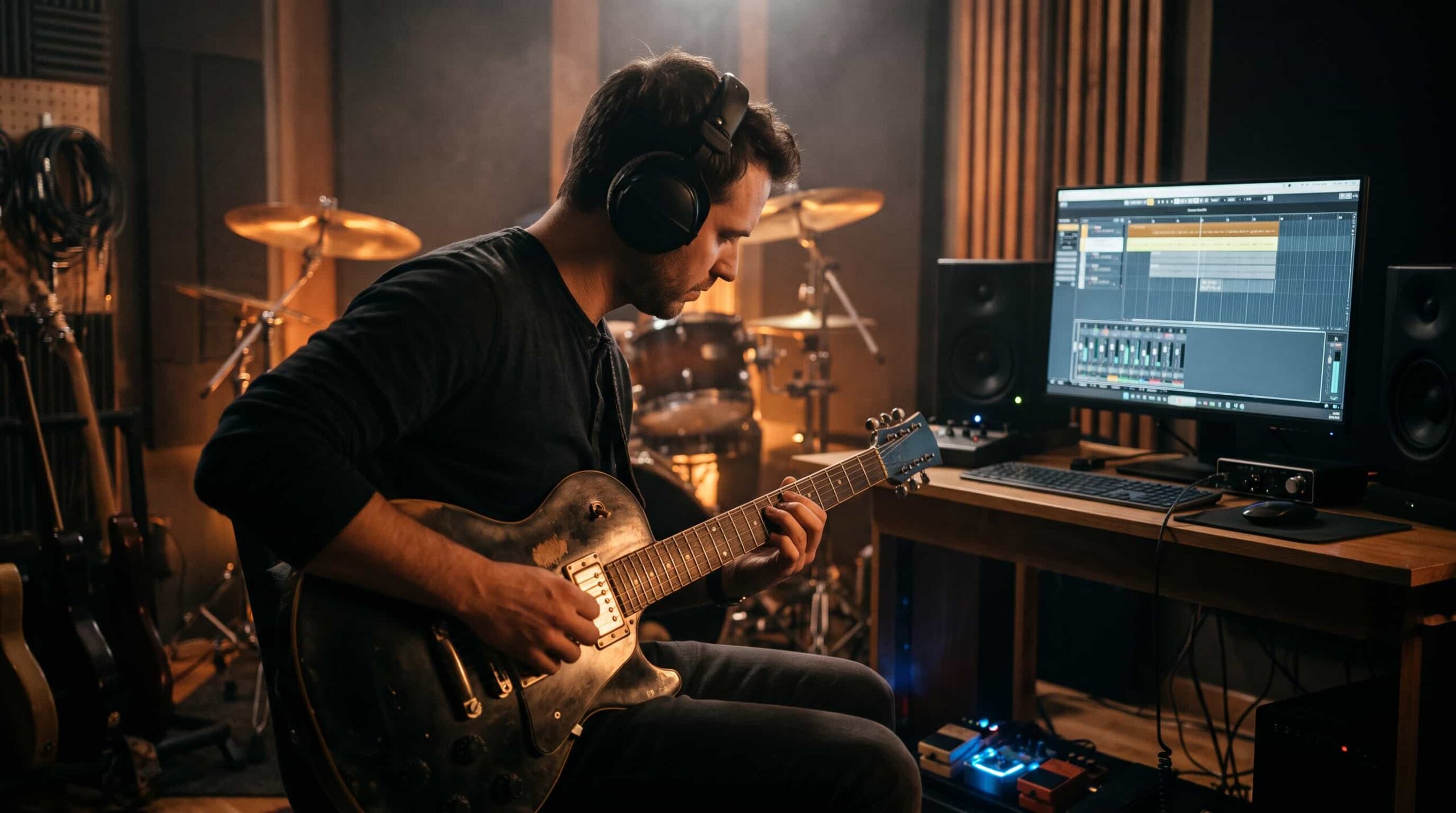
Do not ignore your picking motion
Timing problems are sometimes technical problems in disguise.
If your pick gets trapped between strings, your fretting hand moves too far or a chord change requires excessive motion, the rhythm may suffer.
This is why timing and technique are connected.
You do not need perfect technique before working on rhythm, but movements that consistently interrupt the pulse deserve attention.
A smaller, more relaxed motion is usually easier to keep in time.
Practise with a real musical phrase
Pure timing exercises are useful, but eventually you need to apply the skill to music.
Choose a riff, chord progression or rhythm part you actually enjoy playing.
Practise it slowly with a metronome.
Then try it with a drum groove.
Finally, play it without either and see whether the pulse still feels stable.
The objective is not to become dependent on practice tools.
They are there to help you build a sense of time that continues when the click disappears.
Good timing eventually feels less mechanical
At first, timing practice can feel very mathematical.
You count beats, subdivisions and BPM.
That is useful.
But the final goal is not to sound like a machine.
Once the pulse becomes reliable, you can begin to play with feel: accents, dynamics, slight changes in articulation and the interaction between notes and silence.
Those musical choices only work when the underlying time is solid.
Start by making the beat dependable.
Then let the music breathe around it.