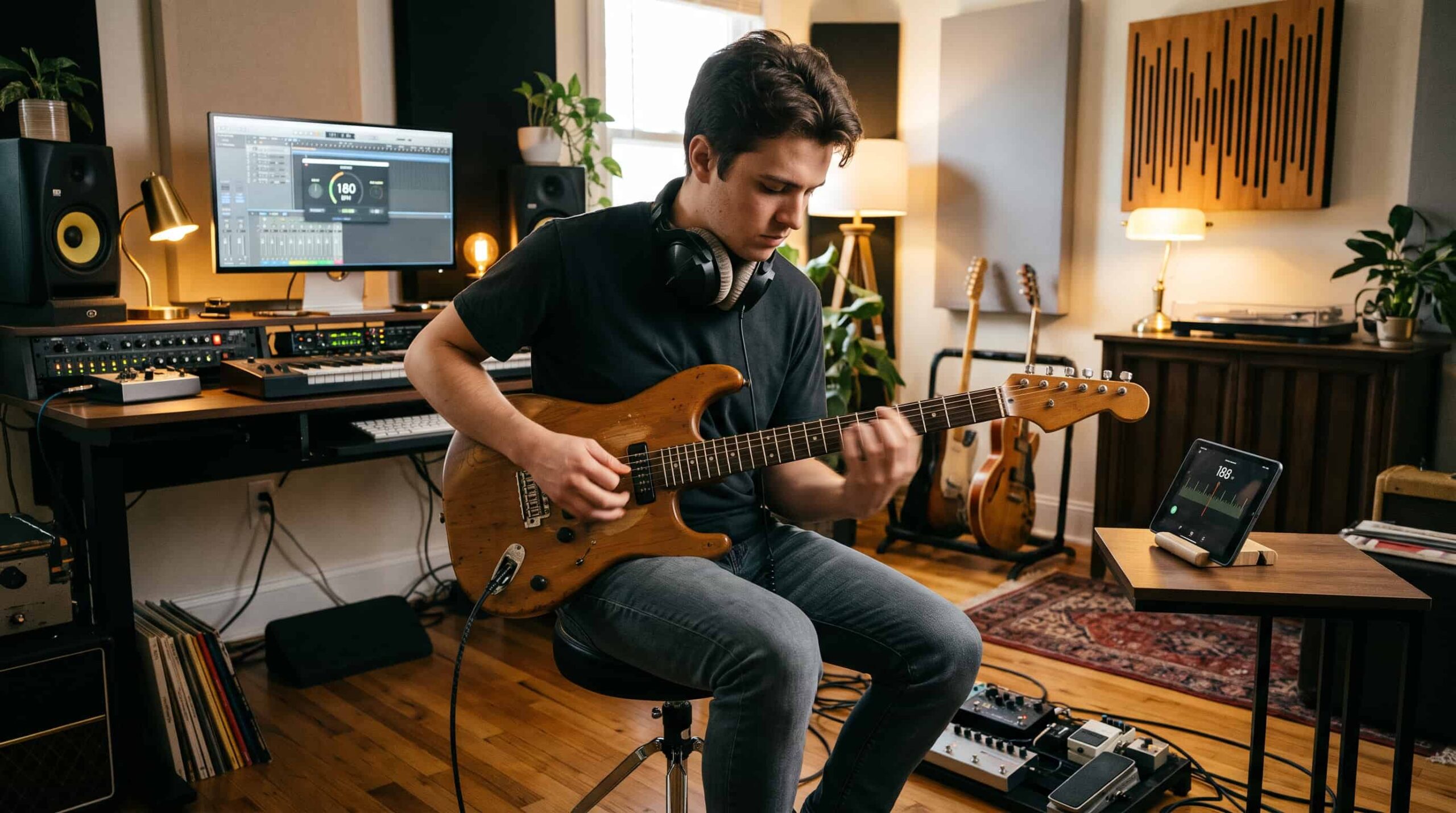
Playing faster is one of the most common goals guitarists set for themselves.
It is also one of the easiest areas of practice to get wrong.
You increase the metronome, manage to survive the exercise at a higher BPM and assume you have become faster. But if the notes are uneven, the picking is tense or half of the phrase disappears under string noise, the number on the metronome is not telling the whole story.
Useful speed is not simply how fast your hands can move.
It is how fast they can move while you remain accurate, relaxed and in control.
Find your real starting tempo
Before trying to increase speed, find the fastest tempo where the exercise still feels comfortable.
That is different from finding the fastest tempo where you can somehow complete it.
Take a short passage, scale sequence, riff or picking exercise and play it several times at the same BPM.
Listen for:
- even timing
- clean note separation
- synchronization between both hands
- unnecessary string noise
- tension in the wrist or forearm
If you can play the phrase cleanly once but the next three repetitions fall apart, that tempo is probably already too high for productive practice.
Your useful starting point is the speed you can repeat consistently.
Increase BPM in small steps
Once the exercise feels stable, increase the tempo gradually.
There is rarely a good reason to jump from 100 BPM directly to 120.
Try something like:
100 → 104 → 108 → 112 BPM
or use increments of 5 BPM.
Small increases allow you to identify exactly where the technique begins to change.
At one tempo everything may feel relaxed. A few BPM later you might notice your pick digging deeper into the strings or your fretting hand becoming tense.
That transition point is important.
It shows you what needs attention before you continue increasing speed.
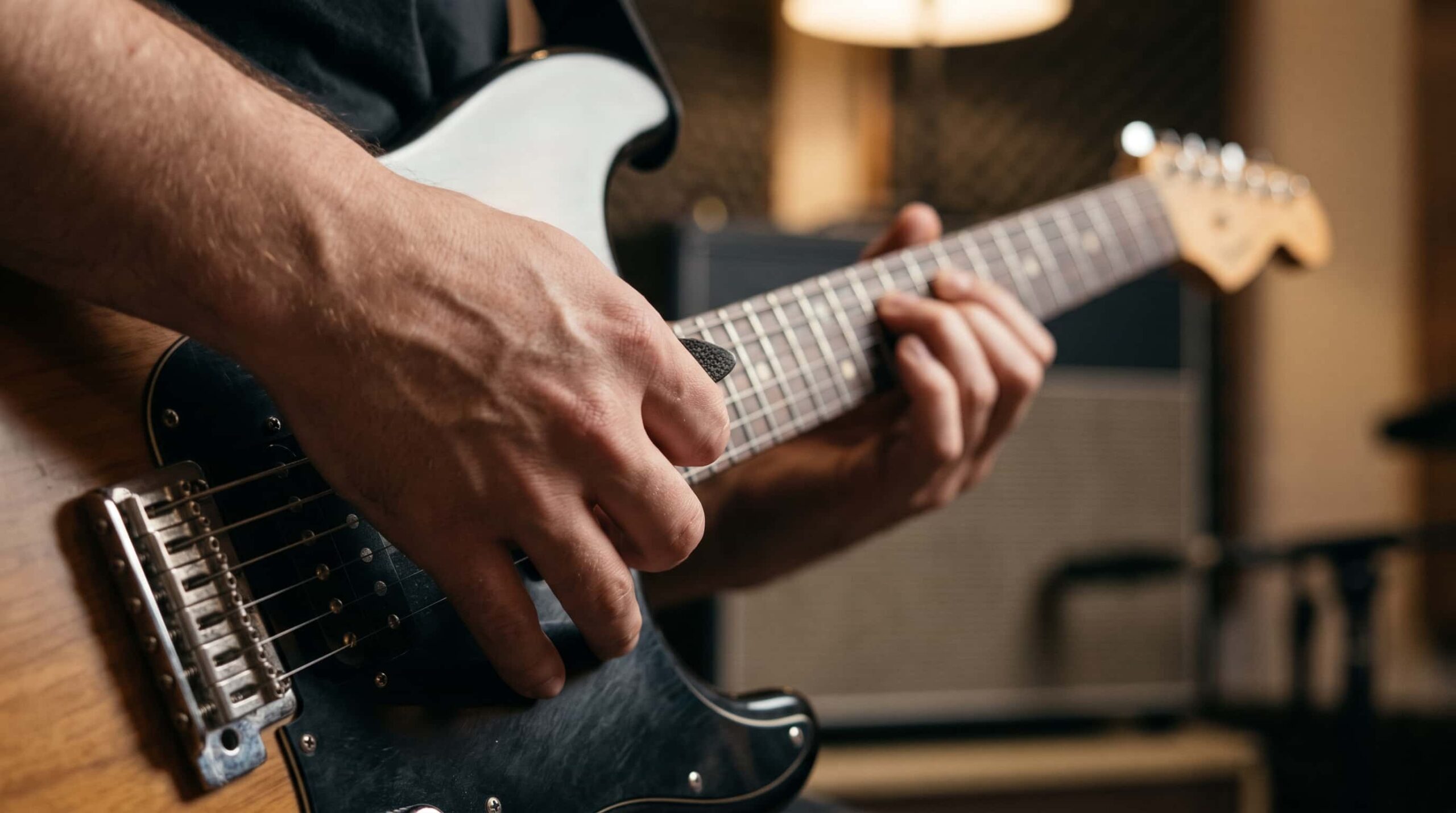
Do not practise mistakes at full speed
When a passage starts breaking down, repeatedly attempting it at the same high tempo can reinforce the problem.
Your hands are still learning.
If every repetition contains the same rushed movement, missed string or tense motion, you are effectively practising that mistake.
Drop the BPM until the movement becomes controllable again.
This does not mean returning to extremely slow practice every time something goes wrong. Sometimes reducing the tempo by just 5 or 10 BPM is enough.
Fix the movement there, then try the faster tempo again.
Use short bursts to experience higher speeds
You do not always have to play the entire exercise at your target tempo.
Short speed bursts can be very effective.
Suppose you can comfortably play a sixteenth-note sequence at 110 BPM but want to reach 130.
Instead of forcing the whole exercise at 130, play only four or eight notes at that tempo.
Stop.
Relax your hand.
Then repeat.
This allows you to experience the faster movement without accumulating tension over a long phrase.
Once the short burst feels natural, extend it:
4 notes → 8 notes → 12 notes → full phrase
The goal is to gradually increase the amount of time you can maintain the faster motion.
Watch for tension before it becomes obvious
Tension is one of the biggest barriers to speed.
At moderate tempos, you can often get away with using more force than necessary. As the BPM rises, those inefficient movements become harder to maintain.
Pay attention to:
- gripping the pick too tightly
- pressing fretted notes harder than necessary
- raising the shoulder
- locking the wrist
- moving the fingers too far away from the fretboard
If tension increases significantly at a particular BPM, do not simply try harder.
Trying harder often creates even more tension.
Reduce the tempo slightly and concentrate on making the movement smaller and easier.
Fast playing usually feels lighter than players expect.
Make sure both hands are actually synchronized
Sometimes the picking hand can move quickly but the fretting hand cannot keep up.
Sometimes the opposite happens.
The result is blurred notes even though both hands individually feel fast.
A useful test is to practise very short patterns where every picked note clearly corresponds to one fretted note.
For example, use a simple four-note-per-string or chromatic sequence and listen carefully to the attack of every note.
If the pick reaches the string before the fretting finger is ready, you will hear a muted or unclear note.
If the fretting finger moves too early, notes may overlap.
Speed requires the two hands to behave like one coordinated system.
Slow practice still matters
Once you begin chasing higher BPMs, it is tempting to stop practising slowly.
That is usually a mistake.
Slow playing gives you time to inspect movements that are difficult to notice at speed.
Take an exercise you normally play at 120 BPM and occasionally practise it at 60 or 70.
Observe:
- how far the pick moves past the string
- whether fingers lift unnecessarily high
- whether both hands move at the same moment
- whether unwanted strings are properly muted
The purpose of slow practice is not simply to make the exercise easier.
It is to give you enough time to see and feel what your technique is actually doing.
Use a working range instead of one maximum BPM
A single personal record is not a very useful measure of technique.
It is better to think in terms of a tempo range.
For example:
Comfortable: 105 BPM
Working: 115–125 BPM
Current limit: 132 BPM
Most practice should happen in the working range.
That is where the exercise requires concentration but remains controllable.
Your limit tempo is useful for testing progress occasionally, but spending the whole session there often produces sloppy repetitions and unnecessary fatigue.
Over time, the working range moves upward.
A tempo that once felt difficult eventually becomes comfortable.
That is a much better sign of progress than hitting a new maximum once.
Practise the difficult fragment, not the whole exercise
Many exercises have one section that limits the entire phrase.
It may be:
- a string change
- a position shift
- an awkward fingering
- an inside-picking transition
- a difficult sweep
- a synchronization problem
Playing the entire exercise repeatedly means you spend most of your time practising the parts you can already play.
Isolate the difficult movement.
If the problem is a six-note string transition, practise those six notes instead of the entire thirty-second phrase.
Once that section improves, put it back into context.
This can make speed development much more efficient.
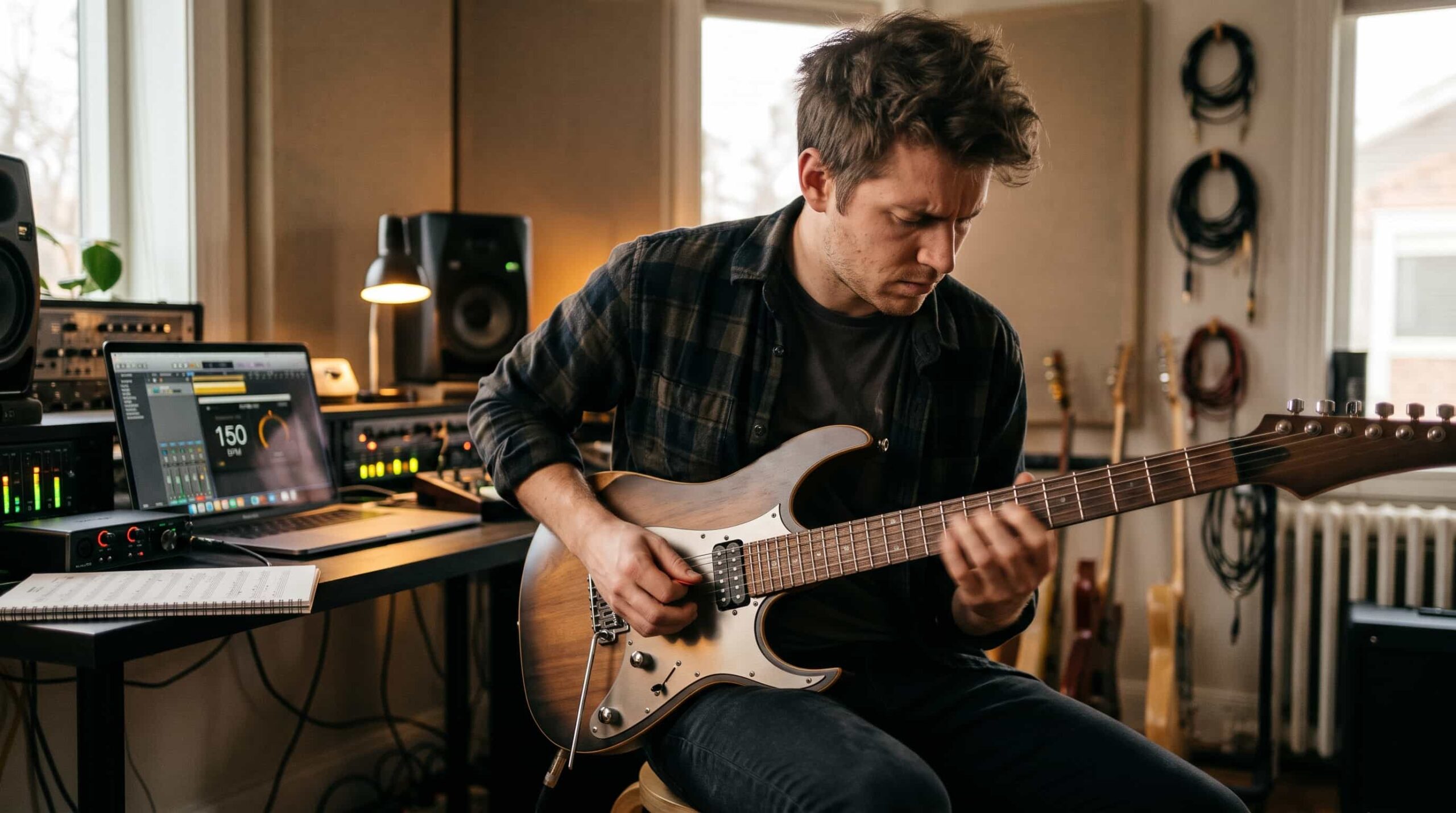
Use a metronome to measure progress, not judge yourself
A metronome gives you an objective reference.
That is useful because memory is unreliable. A passage may feel faster or slower depending on the day.
Recording the BPM removes that uncertainty.
But the number should be treated as information, not a score.
If you played cleanly at 125 BPM yesterday but only feel comfortable at 118 today, there is no reason to force 125.
Fatigue, concentration, warm-up and even stress can affect performance.
Use BPM to track the general direction over weeks, not to demand a personal best every session.
Speed Trainer can automate gradual increases
One useful way to practise speed is to let the metronome increase the BPM automatically.
Instead of stopping after every repetition to change the tempo manually, you can define:
- starting BPM
- target BPM
- size of each increase
- time between increases
For example:
Start: 90 BPM
Target: 120 BPM
Increase: 5 BPM
Every: 60 seconds
You then concentrate entirely on playing.
If the technique starts breaking down at 110 BPM, you have discovered a useful current boundary.
Next time, you might spend more time around 105–110 rather than immediately aiming for 120.
The GuitarNexus Metronome includes a Speed Trainer specifically for this kind of structured practice.
Accuracy should decide when you increase the tempo
There is no universal rule such as “play an exercise five times perfectly before increasing the BPM.”
For some exercises, five repetitions may be enough.
For others, you may need several sessions at the same tempo.
A better question is:
Does this movement feel reliable enough that increasing the tempo will still allow me to practise it correctly?
If the answer is yes, raise the BPM slightly.
If not, stay where you are.
Progress does not always happen during the session itself.
Sometimes you practise at the same tempo for several days and then suddenly find that the next speed feels much easier.
Speed is the result of efficient movement
The fastest guitarists are not simply moving their hands with more effort.
They are usually wasting less movement.
Their picking motion is smaller. Their fingers remain closer to the fretboard. Their hands stay synchronized and unnecessary tension is reduced.
That is why speed cannot be separated from accuracy.
If you build a clean, efficient movement and gradually expose it to higher tempos, speed tends to follow.
Trying to force speed first and repair the technique later is much harder.
Start at a tempo you can control. Increase it gradually. Pay attention when accuracy or relaxation begins to disappear.
The goal is not to make the metronome display a bigger number.
It is to reach that number and still sound like you are completely in control.